
Bus Accidents

Washington Bus Accident Lawyer

Seattle Truck Law represents people injured in bus accidents throughout Washington State, including Seattle, Tacoma, Spokane and Olympia, and offers free case reviews.

A passenger bus crash can injure many people at once with potentially lasting consequences. People in smaller vehicles, pedestrians, and bicyclists can also suffer catastrophic injuries when they are hit by a full-size bus. When a school bus is involved, children, parents, school employees, and other motorists may suddenly face serious injuries and difficult questions about who was responsible.

Get Your Free Case Evaluation

This field is for validation purposes and should be left unchanged.
Name*

Quick Answer

What Factors Can Be Involved in Bus Crashes?

Driver Fatigue Federal hours-of-service rules for covered passenger-carrying commercial vehicles differ from the rules for property-carrying trucks. The Federal Motor Carrier Safety Administration (FMCSA) generally prohibits a bus driver from driving more than 10 hours after eight consecutive hours off duty or from driving after being on duty for 15 hours following eight consecutive hours off duty. The rules that apply can depend on the bus and type of operation involved. In a school bus case, an investigation may also need to examine the driver’s schedule, employment duties, and activities before the crash to determine whether fatigue contributed.

Distracted or Unsafe Driving Phone use, navigation equipment, radio communications, paperwork, or activity inside the bus can distract a driver. Speeding, following too closely, unsafe lane changes, and taking turns too quickly can also lead to serious crashes. For school bus drivers, safe operation also requires accounting for children entering, leaving, and riding the bus, as well as other motorists and pedestrians near schools and bus stops.

Dangerous Turns and Blind Areas Large buses have substantial blind areas and require more space to turn than passenger cars. They frequently operate near crosswalks, sidewalks, bus stops, bicycle routes, and—in the case of school buses—areas where children may be walking or crossing the street. Intersections and left turns are particularly common locations of crashes and incidents involving pedestrians in crosswalks.

Poor Inspection or Maintenance When a mechanical problem may have contributed to a crash, investigators should determine when the bus was last inspected, whether defects had been reported, what repairs were performed, and who was responsible for maintenance.

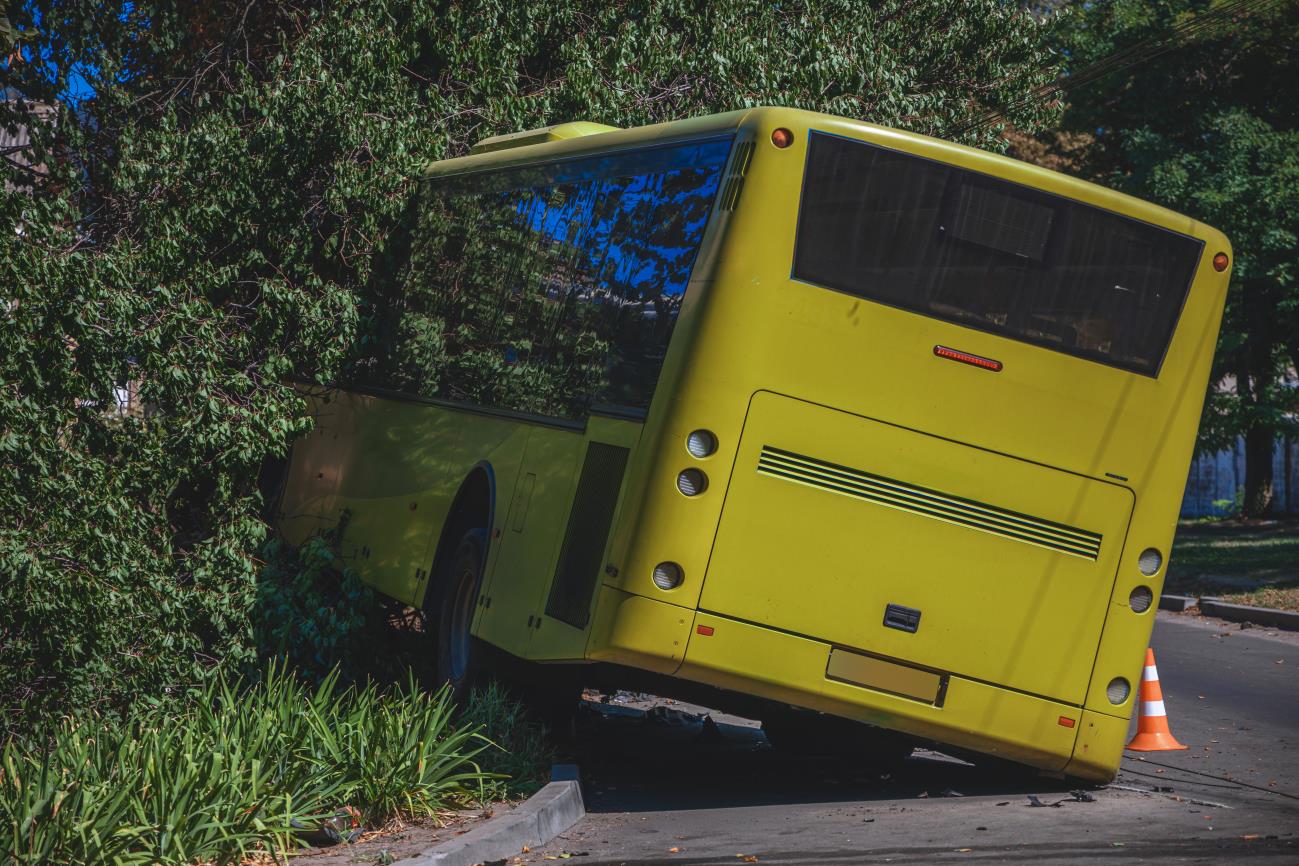
Yellow bus crashed off the road into roadside bushes

Who May Be Responsible for a Bus Accident?

Responsibility depends on what caused the crash and how the transportation operation was structured. Given the variety of factors that may contribute to a crash, more than one party could bear responsibility even if they were never at the scene.

Potentially responsible parties may include:

  • The bus driver
  • A private bus company or motor carrier
  • The driver’s employer
  • A public transit agency
  • A school system or other entity responsible for student transportation
  • A private company contracted to operate school buses
  • A maintenance contractor
  • The bus owner
  • A manufacturer of defective equipment
  • A governmental entity responsible for a dangerous roadway condition, when applicable
  • Another negligent motorist

Important Evidence After a Bus Crash

Bus companies, transit agencies, school systems, and transportation contractors may possess evidence an injured passenger cannot obtain at the scene of a crash. Such evidence might include:

  • Onboard or driver-facing video
  • Electronic vehicle, GPS, and telematics data
  • Driver qualification and training files
  • Hours-of-service records when applicable
  • Dispatch records and route schedules
  • Inspection, maintenance, and repair records
  • Passenger manifests, student transportation records, or ticketing information
  • Cellphone and communications records
  • Police reports, photographs, and witness statements

Video and electronic information may be overwritten, and damaged vehicles can be repaired or returned to service. Prompt investigation matters, and an experienced bus accident lawyer knows how to preserve evidence before something happens to it.

Seattle Truck Law, PLLC focuses on serious crashes involving large trucks and buses. We understand that a bus accident is not simply a larger car accident. Depending on the type of bus and route involved, a case may require investigation of federal motor carrier regulations, public-transit rules, driver qualifications, hours-of-service records, maintenance files, onboard video, and electronic vehicle information.

If you or someone you love was seriously injured in a passenger or school bus crash—or your family lost a loved one—Seattle Truck Law can investigate what happened and help you understand your options.

What Types of Bus Accidents Do We Handle?

Passenger transportation takes many forms in Washington. A serious bus case may involve intercity or long-distance buses, charter buses, tour buses, public transit buses, airport or hotel shuttles, casino or event shuttles, private employee buses, school buses, and other commercial or government-operated passenger vehicles.

The legal issues can differ depending on the operator, route, passenger capacity, and whether the transportation is public or private. Identifying the responsible entities is an important early step.

Claims Against Public Transit Agencies and Other Governmental Entities Require Special Attention

Not every passenger bus is operated by a private company. Washington residents and visitors rely on public transit agencies throughout the state, and some school transportation also involves public entities.

Claims involving local governmental entities can be subject to special procedures. Under RCW 4.96.020, a damages claim against a Washington local governmental entity generally must be presented to the entity’s designated agent before a lawsuit is filed. The statute also generally requires 60 calendar days to pass after presentment before an action may begin.

Claims against the State of Washington have separate presentment requirements under RCW 4.92.100 and RCW 4.92.110.

When a public school, school district, transit agency, or another governmental entity may be involved in a bus accident, an attorney can determine which rules and claim procedures apply. Families should not assume that a claim involving a school bus follows the same process as one involving a privately operated charter or tour bus.

What Kinds of Compensation May Be Needed After a Bus Crash?

Bus crashes can cause traumatic brain injuries, spinal cord injuries, fractures, internal injuries, amputations, crush injuries, burns, nerve damage, and permanent disabilities. All of these can have severe and lasting consequences on a victim’s life.

Injuries to children require particularly careful consideration. A serious injury may affect a child’s education, development, future ability to work, independence, or need for medical and personal care for years to come. The complete effects may not be obvious immediately after the accident.

Depending on the facts and Washington law, damages may include past and future medical expenses, rehabilitation, lost income, reduced earning capacity, disability-related needs, pain and suffering, and other losses caused by the crash.

When a bus crash is fatal, Washington wrongful death and survival laws may provide claims in qualifying circumstances. Under RCW 4.20.010, a personal representative may bring a wrongful death action when a death results from another person’s wrongful act, neglect, or default. Other provisions of Chapter 4.20 RCW govern beneficiaries and survival claims.

We can help you determine the full extent of your case and what forms of compensation you will need now and through the future. It’s important to conduct a full calculation before accepting any settlement offers, as a victim is usually prevented from later pursuing additional compensation after agreeing to a final settlement.

Talk to Seattle Truck Law for Help with Your Bus Crash Case

Seattle Truck Law focuses on serious truck and bus litigation. We work to preserve evidence, investigate transportation companies and public entities when appropriate, identify the rules that apply, and build a case that reflects the full impact of a catastrophic injury or death.

We represent injured people and families throughout Washington, including Seattle, Tacoma, Olympia, Spokane, and communities across the state. We also handle appropriate truck and bus cases elsewhere in the country with local counsel.

If you or someone you love has been seriously injured in a passenger bus accident—or your family has lost a loved one—call 866-580-HURT (4878) or contact Seattle Truck Law online to request a free initial consultation.

Vehicles Where This Happens

Related Accident Causes

Frequently Asked Questions About Bus Accidents

The Federal Motor Carrier Safety Administration’s 2022 Large Truck and Bus Crash Facts report estimates that approximately 19,000 people were injured in bus crashes nationwide in 2022. It also estimates about 10,000 injury crashes involving buses that year.

Federal Transit Administration data highlights a different injury risk. From 2008 through 2023, public-transit bus modes reported 8,230 bus-to-person collisions involving pedestrians, bicyclists, and others outside motor vehicles. Those collisions resulted in 8,259 injuries and 596 deaths. FTA data also shows that collisions between transit buses and non-transit motor vehicles produced 50,739 injuries from 2016 through 2023.

Seek appropriate medical care first. Keep any ticket, reservation, itinerary, receipt, or other document identifying the bus and trip. If possible, preserve photographs, videos, witness information, police paperwork, and communications from the bus company or insurer.

You should also contact a bus accident lawyer promptly because onboard video, electronic records, and company documents may need to be preserved.

Make sure your child receives appropriate medical attention, even if the full extent of the injuries is not immediately clear. Keep records of medical treatment and preserve any information you receive from the school, school district, bus operator, police, or insurance company.

You should also identify who actually operated the bus. Some school buses may be operated by a public school system, while others may be operated by private transportation contractors. That distinction can affect which parties need to be investigated and what procedures apply to a claim.

Because video, vehicle data, driver records, and other evidence may not be kept indefinitely, contacting a bus accident attorney promptly can help ensure important information is identified and preserved.

It can be.

School bus cases may involve children, school systems, private transportation contractors, and governmental entities. Questions can arise concerning who employed the driver, who owned and maintained the vehicle, who controlled transportation policies, and whether special procedures apply before a lawsuit can be filed.

A bus accident lawyer should identify the bus operator and responsible entities early so the claim can be handled under the correct rules.

A claim involving a governmental transit agency can involve special claim-presentment requirements before a lawsuit may proceed. The exact procedure depends on the entity involved, so identifying the operator quickly is important.

Another motorist may be partly or entirely responsible, but that should be determined from evidence. The bus driver’s actions, carrier practices, vehicle condition, roadway evidence, witnesses, and electronic information may all matter. More than one party can share responsibility for the same crash.

Washington generally provides a three-year limitations period for actions involving injury to a person, but the correct deadline depends on the circumstances. Government claims can also involve claim-presentment procedures.

Do not use the general limitations period as a reason to delay. Video, electronic data, and company records may disappear much sooner.

There is no reliable average settlement amount. The value of each case depends on the severity and permanence of the injuries, future medical needs, lost income, reduced earning ability, pain and suffering, available insurance, disputed fault, and the strength of the evidence.

For an injured child, determining the long-term effects of the injury may be especially important before evaluating a potential resolution.

No. Which federal rules apply can depend on vehicle size, passenger capacity, whether the operation is for hire, whether the transportation is interstate, and other characteristics of the operation. School transportation can involve its own regulatory considerations as well.

A bus investigation should begin by identifying the operator, vehicle, route, purpose of the transportation, and entities responsible for operating and maintaining the bus.

client testimonials

Contact the Seattle Truck Law Team Today

If you’ve been injured in a trucking accident, contact Seattle Truck Law at (866) 580-4878 or fill out our online form for a free consultation. You pay no fees or expenses unless we recover compensation on your behalf. Don’t wait—the sooner you contact us, the sooner our attorneys can preserve evidence, investigate your claim, and start building your case.

This field is for validation purposes and should be left unchanged.
Name*