
Dump Truck Accidents

Washington Dump Truck Accident Lawyer

Seattle Truck Law represents people injured in dump truck accidents throughout Washington State, including Seattle, Tacoma, Spokane and Olympia, and offers free case reviews.

Dump trucks are a familiar sight, hauling materials throughout Washington every day. When these trucks are operated safely, they are an essential part of the construction and transportation industries. But when a dump truck driver, trucking company, contractor, or other responsible party cuts corners on safety, the consequences can be devastating.

Get Your Free Case Evaluation

This field is for validation purposes and should be left unchanged.
Name*

Quick Answer

Dump Truck Crashes Cause Serious Injuries in Washington

Federal crash data confirms that dump trucks are regularly involved in serious roadway crashes.

The Federal Motor Carrier Safety Administration's 2024 cargo-body data recorded 158 large trucks with dump bodies involved in federally reportable crashes in Washington. Nationwide, the same database recorded 13,907 dump-body large trucks involved in reportable crashes during 2024.

A federally reportable commercial motor vehicle crash generally involves a fatality, an injury requiring immediate treatment away from the scene, or disabling damage requiring a vehicle to be towed. So not every collision involving a dump truck is represented here.

According to FMCSA's Large Truck and Bus Crash Facts 2022, 463 large trucks with dump cargo bodies were involved in fatal crashes nationwide in 2022, accounting for 7.9% of large trucks involved in fatal crashes that year.

But statistics cannot fully describe what a catastrophic crash can do to an individual or family. A person injured by a dump truck may face traumatic brain injuries, spinal cord damage, fractures, amputations, internal injuries, permanent disability, chronic pain, and years of rehabilitation. Families dealing with a fatal crash may suddenly face grief, lost income, funeral expenses, and a future that looks nothing like the one they had planned.

That is why a serious dump truck case deserves an expert investigation.

Who Can Be Responsible for a Dump Truck Crash?

The driver may be responsible for a crash, but the investigation should not necessarily stop with them.

Depending on the facts, responsibility could involve:

The driver

The driver's employer

The motor carrier

The truck owner

A loading company

A maintenance contractor

A construction contractor

A manufacturer of defective equipment

Another entity whose negligence contributed to the crash

Identifying the correct defendants is one of the major differences between a commercial trucking case and an ordinary car accident claim. A quick insurance investigation may focus almost entirely on the driver’s actions. A dump truck accident lawyer should look farther.

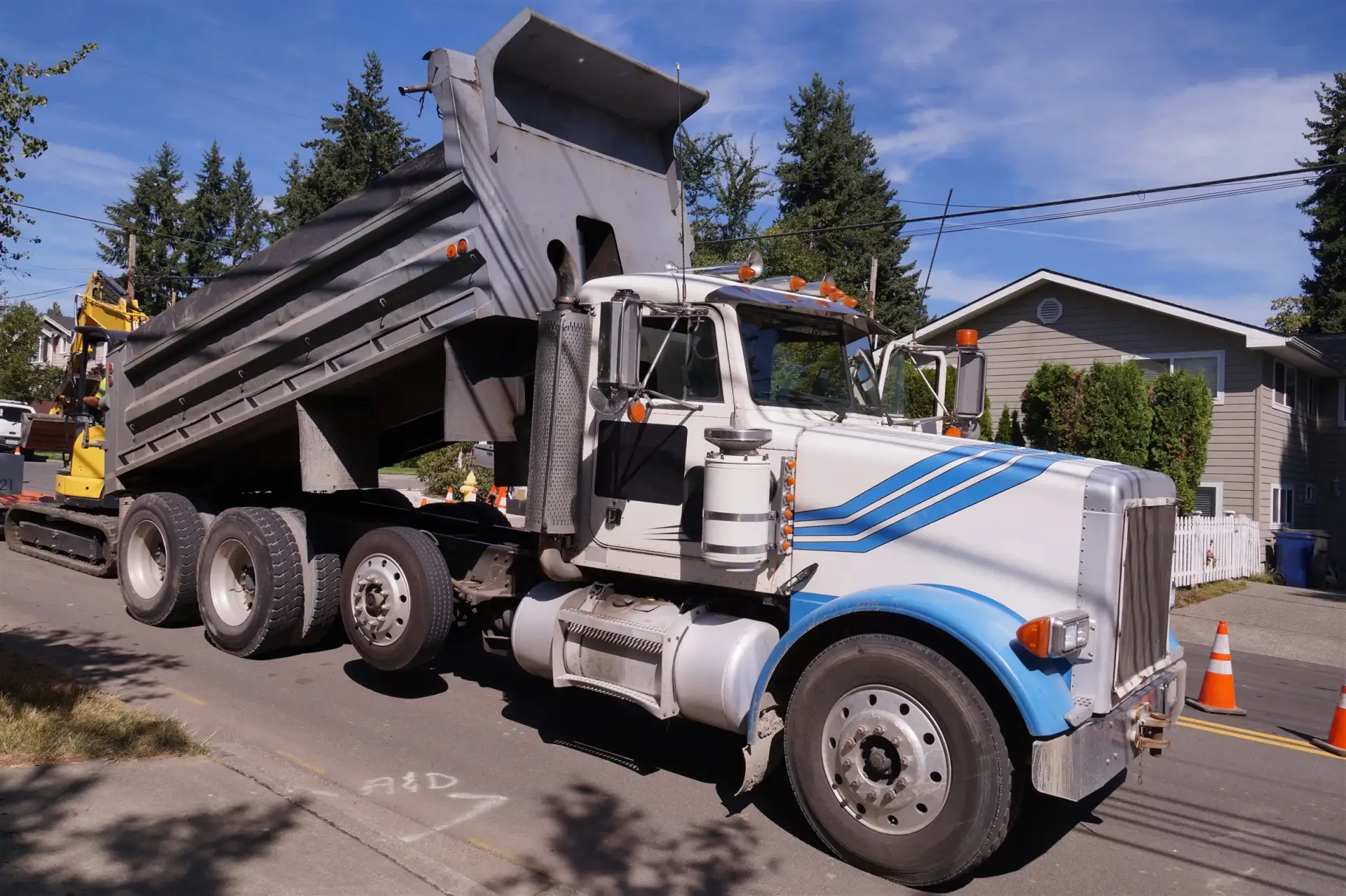
Dump truck with its bed raised at a roadside work zone

Why Are Dump Trucks So Dangerous?

Many of the characteristics that make dump trucks useful also create unique risks.

Dump Trucks Carry Extremely Heavy Loads

Dump trucks are designed to transport heavy material. A heavily loaded truck requires significantly more care from its driver, particularly when approaching intersections, traveling downhill, following traffic, or operating in wet and icy Washington conditions.

Overloading may affect braking and handling, increase stress on tires and mechanical components, and contribute to instability. A thorough investigation should determine what the truck was carrying, where the load came from, what it weighed, and whether the truck was legally and safely loaded.

A Shifting or Uneven Load Can Affect Stability

Dump trucks frequently carry loose material rather than uniformly packaged freight. If a load is improperly distributed, shifts during transportation, or sticks to one side of the bed during unloading, the truck’s balance can change.

A high or uneven center of gravity can make a commercial vehicle more susceptible to a rollover, particularly during curves, abrupt steering maneuvers, or unloading operations. Investigators may need to examine not only how much the truck was carrying but how the material was placed in the bed and whether loading practices contributed to the crash.

Dump Trucks Have Significant Blind Spots

Drivers of large commercial vehicles cannot see everything around them. Dump trucks may have substantial blind areas directly behind the vehicle and along its sides.

That can be especially dangerous because dump trucks frequently enter and leave construction sites, back across work areas, cross sidewalks, operate around pedestrians and workers, and move between private property and public roads.

A driver still has a responsibility to make sure a movement can be completed safely. Depending on the circumstances, questions may arise about mirrors, cameras, spotters, site procedures, traffic control, driver training, or whether the company had appropriate backing policies.

Loose Material Can Escape from the Truck

A dump truck crash does not always require the truck itself to hit another vehicle.

Rocks, gravel, dirt, construction debris, and other material can fall or blow from a truck. A large object may strike a windshield or motorcyclist directly. Smaller debris can cause drivers to brake, swerve, lose control, or collide with surrounding traffic.

Washington has specific laws addressing these hazards. RCW 46.61.655 generally prohibits operating a vehicle on a public highway when its load can drop, sift, leak, or otherwise escape. Dirt, sand, and gravel susceptible to escaping from a vehicle traveling on a paved public highway generally must be covered, although some exceptions may exist.

What Causes Dump Truck Accidents?

There is rarely a good reason to assume the cause of a commercial truck crash before investigating it. What initially looks like simple driver error may turn out to involve contributing factors—even from parties who were nowhere near the accident scene.

Speeding and Unsafe Driving

Dump trucks operators might compete against compensation structures or tight schedules that create pressure to complete more daily trips in less time. However, that pressure cannot justify speeding, following too closely, running traffic controls, or driving too fast for conditions.

A dump truck accident lawyer’s investigation may include dispatch records, trip records, GPS or telematics information, load tickets, delivery times, and other evidence that helps reconstruct the driver’s movements before the crash.

Driver Fatigue

Commercial drivers who are subject to federal hours-of-service rules face limits on how long they may drive and work before taking required rest. For example, covered property-carrying commercial drivers generally may drive no more than 11 hours after 10 consecutive hours off duty and generally may not drive beyond the 14th consecutive hour after coming on duty.

Not every dump-truck operation is subject to the same federal recordkeeping requirements. Local and short-haul operations can raise different regulatory questions. That makes it important to determine which rules actually applied rather than assuming every dump truck driver should have the same electronic logs as a long-haul tractor-trailer driver.

When fatigue is suspected, records such as timecards, dispatch information, electronic logs when applicable, fuel receipts, load tickets, phone records, and GPS data can help establish how long the driver had been working.

Distracted Driving

Commercial drivers need their full attention on the roadway. FMCSA prohibits covered commercial motor vehicle drivers from texting while driving and restricts the use of handheld mobile phones.

After a serious crash, evidence concerning phone use may need to be preserved quickly.

Poor Maintenance and Mechanical Failures

Brakes, tires, steering systems, lights, suspension components, hydraulic systems, and other equipment all play important roles in safe dump-truck operation.

Federal motor carrier regulations establish inspection, repair, maintenance, and recordkeeping requirements for covered commercial vehicles. A brake failure or tire problem should therefore lead to questions beyond whether a component broke. Investigators may need to determine when that component was last inspected, whether the company knew about previous problems, whether repairs were performed correctly, and whether the truck should have been on the road at all.

Improper Loading and Unsecured Cargo

Cargo rules in dump-truck cases can be more complicated than they first appear.

Federal cargo-securement regulations apply to many types of cargo carried by commercial vehicles. However, FMCSA specifically notes that certain bulk commodities without a fixed shape—including sand, gravel, and aggregates transported in a hopper, box, or similar structure forming part of the commercial vehicle—are treated differently under the federal cargo-securement rules. Washington’s load-covering and anti-spillage requirements can therefore become particularly important in dump-truck cases.

Other loads, including machinery, construction materials, equipment, large objects, or demolition materials, may raise different securement questions.

A dump truck accident lawyer investigating the crash needs to understand what the truck was hauling and which regulations applied to that load.

What Compensation May Be Available After a Serious Dump Truck Crash?

No lawyer can determine the value of a dump truck injury claim based only on the type of crash. The harm suffered by each person is different.

Depending on the circumstances, a claim may involve but is not limited to: 

  • Past and future medical expenses
  • Rehabilitation
  • Lost income
  • Diminished earning capacity
  • Permanent disability
  • Pain and suffering
  • Loss of normal activities

Catastrophic injuries require special attention to the future. A person with a spinal cord injury, brain injury, amputation, or other permanent impairment may need decades of medical treatment, assistance, equipment, home modifications, or support. Resolving a case without fully understanding those future needs can leave an injured person without the resources necessary later in life.

When a dump truck crash is fatal, certain surviving family members or the estate may also have claims under Washington law. Fatal cases require a careful evaluation of the family’s circumstances and the specific wrongful-death and survival laws that apply.

Why Work with a Dump Truck Accident Lawyer?

At Seattle Truck Law, PLLC, we have specialized experience handling serious crashes involving commercial trucks and vehicles. Determining why a dump truck crash happened may require an investigation into the driver, the truck, its load, the company operating it, the construction project it was serving, and the federal and Washington safety rules that applied. If you or someone you love suffered a serious injury or lost someone in a fatal crash, the dump truck accident lawyers at Seattle Truck Law can help you understand what happened and what legal options may be available.

A trucking company’s insurer may begin investigating a serious wreck immediately. The injured person and family should have someone investigating for them as well.

Dump-truck cases can involve commercial driving regulations, maintenance requirements, loading practices, company safety policies, electronic evidence, multiple corporate defendants, and experts in fields such as accident reconstruction, trucking safety, engineering, medicine, life-care planning, and economics.

Seattle Truck Law concentrates on cases involving commercial trucks, buses, and other large vehicles. We represent seriously injured people and families throughout Washington, including Seattle, Tacoma, Olympia, Spokane, and communities across the state. We can also work with local counsel when handling appropriate cases outside Washington.

Talk to Seattle Truck Law About a Dump Truck Crash

A devastating dump truck crash can leave you facing medical bills, lost income, permanent injuries, or the death of someone you love. At the same time, the trucking company and its insurer may already be gathering information and deciding how they intend to defend the case.

You deserve the opportunity to understand what happened.

Seattle Truck Law, PLLC represents people seriously injured in commercial truck crashes and families who have lost loved ones. We know how to investigate trucking companies, analyze commercial vehicle evidence, work with qualified experts, and build cases involving complex truck-safety issues.

If you or a loved one has been injured in a dump truck accident, call 866-580-HURT (4878) or contact Seattle Truck Law online to request a free initial consultation.

Vehicles Where This Happens

Related Accident Causes

Frequently Asked Questions About Dump Truck Accidents

Your health comes first. Seek appropriate medical care and follow your doctors’ recommendations. If you are able, preserve any photographs, videos, witness information, police paperwork, medical documents, and insurance correspondence related to the crash.

Avoid assuming that the dump truck company’s insurer will preserve every piece of evidence needed for your claim. Serious commercial vehicle crashes may involve company records and electronic information that should be identified and preserved early.

You may still have a claim even if the dump truck never physically struck your vehicle.

Washington law requires vehicle loads to be transported in a manner that prevents material from escaping and contains additional requirements for dirt, sand, and gravel transported on paved public highways.

A successful claim will depend on proving where the material came from, how it escaped, and how it caused your injuries. Photographs, dash-camera footage, witnesses, truck identification information, and nearby surveillance footage can be particularly important.

That depends on how and why the overloading occurred.

The driver may have known the truck was improperly loaded. A trucking company may have encouraged unsafe loads or failed to enforce weight limits. Another business may have loaded the truck. Records from scales, quarries, suppliers, construction sites, or disposal facilities may help establish the actual weight and origin of the load.

A trucking investigation should determine who controlled each part of the operation rather than automatically assigning all responsibility to the person behind the wheel.

A disagreement over fault does not necessarily end your case.

Washington law provides that a claimant’s share of fault generally reduces compensatory damages in proportion to that person’s percentage of fault. In other words, being assigned some responsibility does not automatically prevent recovery.

Fault should be determined based on evidence, not simply on what a truck driver or insurance adjuster says happened.

Washington generally provides a three-year limitations period for actions involving injury to a person. However, the correct deadline can depend on the type of claim, the parties involved, when the claim accrued, and other circumstances. Claims involving government entities or unusual factual situations can involve additional requirements or deadlines.

Potentially. The answer depends on the driver’s relationship with the company and the facts surrounding the crash.

A company may also face responsibility for its own conduct—for example, unsafe hiring or training practices, inadequate supervision, dangerous scheduling, poor maintenance, or other failures that contributed to the collision.

Dump-truck operations sometimes involve contractors and owner-operators, which can make the relationships between the people and companies involved more complicated. Those relationships should be investigated.

Your family may have legal options, but fatal truck crashes require careful handling.

In addition to determining exactly why the crash happened, an attorney may need to evaluate Washington’s wrongful death and survival laws, identify the people legally entitled to pursue claims, calculate the financial and personal losses caused by the death, and preserve evidence against the trucking company and other responsible parties.

You should not have to conduct that investigation while your family is grieving.

client testimonials

Contact the Seattle Truck Law Team Today

If you’ve been injured in a trucking accident, contact Seattle Truck Law at (866) 580-4878 or fill out our online form for a free consultation. You pay no fees or expenses unless we recover compensation on your behalf. Don’t wait—the sooner you contact us, the sooner our attorneys can preserve evidence, investigate your claim, and start building your case.

This field is for validation purposes and should be left unchanged.
Name*