
Blind Spot Truck Accidents

Washington Truck Blind Spot Accident Lawyers

Large commercial trucks have blind spots that can hide an entire passenger vehicle from the driver’s view, sometimes called truck “no-zones.” When a truck driver changes lanes, merges, turns, or backs without adequately accounting for traffic in those areas, the results can be catastrophic.

Seattle Truck Law, PLLC focuses on serious crashes involving commercial trucks and buses. If you or someone you love was injured when a truck merged into your vehicle, sideswiped you, or otherwise caused a crash involving a blind spot, contact our Washington truck lawyers for a free consultation and discussion of your next steps.

Get Your Free Case Evaluation

This field is for validation purposes and should be left unchanged.
Name*

Quick Answer

What Are a Truck's Blind Spots?

A blind spot is an area around a vehicle that the driver cannot see directly or adequately through available mirrors or other visibility systems.

Passenger cars also have blind spots, but commercial truck no-zones are often much larger. Federal Motor Carrier Safety Administration (FMCSA) safety materials illustrate blind areas extending roughly 20 feet in front of a truck, 30 feet behind it, one lane to the driver’s left, and as many as two lanes to the right. The exact area varies by vehicle and mirror configuration.

The right side of a truck can be particularly dangerous because the driver sits on the left side of the cab and may have difficulty seeing smaller vehicles traveling alongside the tractor or trailer.

Truck Drivers Are Expected to Account for Their Blind Spots

A large blind spot is a known characteristic of a commercial vehicle and shouldn’t be treated as a sudden emergency surprise.

Washington’s own Commercial Driver Guide instructs commercial drivers to regularly check mirrors for traffic to the sides and rear and specifically warns that those mirrors can’t show every blind spot. Drivers are advised to monitor whether other vehicles move into blind areas and to perform additional checks during lane changes, turns, merges, and tight maneuvers.

The FMCSA similarly recommends that truck and bus drivers check mirrors every 8-10 seconds to remain aware of traffic moving into their blind spots.

Common Types of Truck Blind Spot Accidents

Unsafe Lane Changes One of the most common truck blind spot scenarios occurs when a tractor-trailer changes lanes into a car traveling beside it.

The truck may strike the vehicle directly, force it into another lane or barrier, or push it underneath the trailer. These crashes most frequently occur on highways such as I-5, I-90, I-405, and other busy Washington freight corridors where trucks and passenger vehicles regularly travel side by side.

Merging Accidents Highway entrances, lane reductions, and construction zones can force vehicles into close proximity.

A commercial driver who merges without recognizing another vehicle in their truck's blind zone can cause a sideswipe or force the other motorist off the roadway.

Wide-Turn Accidents Tractor-trailers need substantially more space to turn than passenger cars.

A truck making a right turn may initially move left before swinging back to the right. An unseen vehicle, cyclist, motorcyclist, or pedestrian beside the truck can then become trapped between the trailer and curb or struck as the trailer tracks through the turn.

Backing Accidents A truck driver may have extremely limited visibility directly behind a commercial vehicle.

Backing accidents can occur at warehouses, loading docks, construction projects, parking areas, delivery locations, alleys, and other places where trucks operate around cars and people.

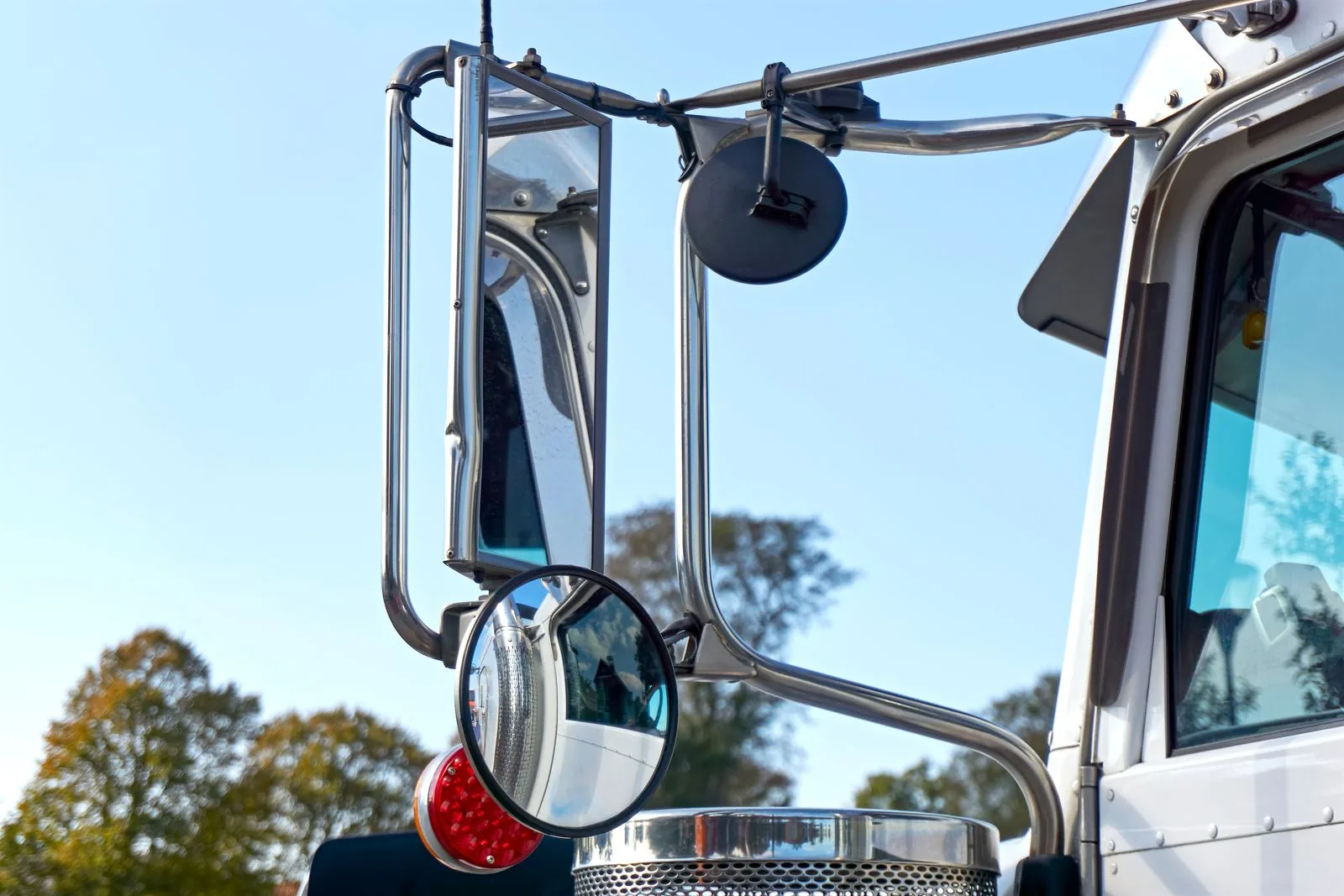
Side mirrors on a commercial truck, including a convex blind spot mirror used to see nearby vehicles

Can a Truck Driver Blame You for Being in the Blind Spot?

A trucking company or insurer may argue that a passenger vehicle should not have been in the no-zone. However, that argument doesn’t automatically establish fault.

Drivers should certainly use care around commercial vehicles, but truck drivers are also trained to recognize those areas and monitor surrounding traffic.

A driver may have seen your vehicle before it entered the blind area, failed to check mirrors regularly, gotten distracted, or made too fast of a lane change. A truck’s mirrors could have been poorly adjusted or defective.

The amount of fault attributed to each party in a case matters under Washington’s comparative fault system. Under RCW 4.22.005, fault assigned to an injured person generally reduces compensatory damages proportionally rather than automatically eliminating the claim.

An insurance adjuster’s accusation should therefore never be the ultimate word on responsibility.


Evidence in a Truck Blind Spot Case

Blind spot cases often depend on reconstructing exactly where each vehicle was located and what the truck driver could reasonably have observed. Seattle Truck Law may investigate pertinent evidence including:

  • Truck and passenger vehicle damage
  • Dashcam and onboard truck video
  • Traffic or surveillance cameras
  • Electronic truck data
  • GPS and telematics information
  • Driver cellphone records
  • Mirror positions and condition
  • Blind spot cameras or detection systems
  • Driver qualification and training files
  • Company lane change and backing policies
  • Witness statements
  • Police photographs and measurements
  • Skid marks and roadway evidence
  • Driver logs and fatigue evidence

Some of this evidence can disappear quickly, either intentionally or not. Electronic information may be overwritten, video can be deleted through routine retention practices, and the truck may be repaired and returned to service. Consulting with a truck accident lawyer quickly after your accident can help ensure evidence is preserved.

Frequently Asked Questions About Truck Blind Spot Accidents

“No-Zone” is a term used for the large blind areas around commercial trucks and buses. These areas generally exist directly in front of and behind the truck and along both sides, with a particularly large blind zone on the passenger side.

The exact size varies according to the truck, trailer, mirrors, cameras, and driver position.

No.

Driving in a truck’s blind spot can create risk, but it does not automatically determine legal responsibility. Washington requires drivers changing lanes or moving laterally to make sure the movement can be completed safely.

The circumstances leading up to the crash must be investigated.

Commercial drivers are expected to monitor surrounding traffic.

Washington’s Commercial Driver Guide specifically instructs truck drivers to use mirrors during lane changes, including checking before changing lanes, after signaling, when beginning the maneuver, and after completing it.

There is no general Washington law requiring every commercial truck to have a blind-spot camera.

Washington does, however, require mirrors on motor vehicles and requires certain cube-style commercial delivery trucks to have a rear crossview mirror or backup device. Federal regulations also generally require rear-vision mirrors on both sides of trucks, truck tractors, and buses.

Whether a particular vehicle had additional camera or detection technology can still be important evidence.

That may be evidence of unsafe driving.

RCW 46.61.305 generally requires an appropriate turn signal before moving right or left and requires the signal to be given continuously for at least the final 100 feet before the movement.

Failing to signal can also make it harder for surrounding motorists to anticipate the truck driver’s intentions.

Backing crashes should be investigated for visibility, mirror condition, cameras or alarms, spotter use, company procedures, and the driver’s actions before moving.

Washington imposes additional rear-visibility requirements on certain cube-style commercial delivery trucks.

Washington generally provides a three-year limitations period for personal injury actions under RCW 4.16.080.

However, claims can involve different requirements and evidence may disappear long before the legal filing deadline. Speaking with a truck accident attorney early can help protect important truck and electronic evidence.

Attorney listening to a client during a consultation in a law office

Talk to Seattle Truck Law After a Blind Spot Truck Crash

A trucking company may try to reduce a blind spot collision to one explanation: “The truck driver couldn’t see you.” But that should be the beginning of the investigation, not the end.

Seattle Truck Law focuses on serious commercial truck and bus litigation. We know how to investigate truck-specific evidence and determine whether a driver’s visibility limitations were properly managed before a catastrophic crash.

If you or someone you love was seriously injured in a Washington truck blind spot accident—or your family lost a loved one—call 866-580-HURT (4878) or contact Seattle Truck Law to request a free initial consultation.

Vehicles Where This Happens

Related Accident Causes

client testimonials

Contact the Seattle Truck Law Team Today

If you’ve been injured in a trucking accident, contact Seattle Truck Law at (866) 580-4878 or fill out our online form for a free consultation. You pay no fees or expenses unless we recover compensation on your behalf. Don’t wait—the sooner you contact us, the sooner our attorneys can preserve evidence, investigate your claim, and start building your case.

This field is for validation purposes and should be left unchanged.
Name*